Male enhancement gummies: what they are and what they actually do
Quick answer
Male enhancement gummies are chewable dietary supplements marketed to support male vitality, drive and everyday performance, usually built from botanicals such as maca, ashwagandha, muira puama or catuaba plus the amino acid L-arginine. They are food-category products, not medicines: they are not approved before sale, they cannot legally claim to treat erectile dysfunction or low testosterone, and no finished gummy in this category has a published clinical trial of its own.
“Male enhancement gummies” is now the shelf label for a whole category, and the phrase does a lot of work it has not earned. This page explains what these products actually contain, what the gummy format changes, what the evidence supports, and what the words on the jar are legally allowed to mean.
What are male enhancement gummies?
A male enhancement gummy is a dietary supplement in confectionery form, usually taken once daily, combining a small number of botanical extracts with an amino acid, in a base of sugar or sugar alcohols, pectin or gelatin, colours and flavours. The active ingredients are the same ones used in the capsule products that preceded them. The format is what is new, not the formula.
The phrase “male enhancement” is marketing vocabulary rather than a regulatory or clinical term. On a compliant label it functions as a category name attached to structure/function claims — supports vitality, supports drive, supports performance — each carrying the asterisk that points to the standard statement that the claim has not been evaluated by the FDA. It does not mean the product treats anything, and a page that uses the phrase to imply otherwise has moved past what its own label permits.
What is actually in them?
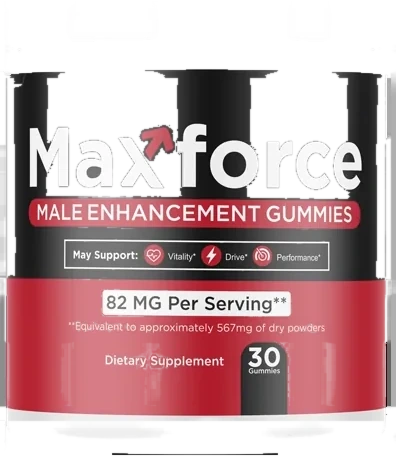
Most formulas draw from a short shared list. The MaxForce jar, which is labelled MALE ENHANCEMENT GUMMIES and holds 30 gummies, is a representative example: muira puama extract, maca extract, catuaba extract, ashwagandha and L-arginine, at a stated 82 mg per serving, footnoted as equivalent to approximately 567 mg of dry powders.
| Ingredient | What it is | Evidence level |
|---|---|---|
| Maca (Lepidium meyenii) | Andean root, eaten as a food; sold in Spanish as maca peruana | Small RCTs on self-reported desire |
| Ashwagandha (Withania somnifera) | Ayurvedic root studied as an adaptogen | Largest human literature; stress and sleep |
| L-arginine | Amino acid; precursor to nitric oxide | Meta-analysis on erectile scores, low quality |
| Muira puama (Ptychopetalum olacoides) | Amazonian bark used in traditional tonics | Mainly traditional and preclinical |
| Catuaba | Brazilian bark used in traditional tonics | Mainly traditional and preclinical |
What does the evidence actually support?
Honestly: less than the category name implies, and not nothing. Ashwagandha has the deepest controlled literature, and it is largely about stress, anxiety and sleep rather than hormones (Cheah et al., PLoS One, 2021). Maca’s most-cited randomised trial reported improved self-reported sexual desire from week eight, explicitly with no change in serum testosterone or oestradiol (Gonzales et al., Andrologia, 2002), and a systematic review judged the maca evidence suggestive but methodologically limited (Shin et al., BMC Complement Altern Med, 2010). A meta-analysis of arginine supplements for erectile dysfunction found improvement in erectile-function scores against placebo, from small trials using varied preparations (Rhim et al., J Sex Med, 2019). The Amazonian barks sit mainly on ethnomedicinal use and animal work (Teixeira et al., J Ethnopharmacol, 2024).
Pooled across the category, a systematic review and meta-analysis of herbal dietary supplements trialled for erectile dysfunction found a small evidence base of limited quality (Ho et al., J Tradit Complement Med, 2026), and a systematic review asking whether testosterone-booster products raise serum total testosterone found most ingredients had no supporting human evidence (Morgado et al., Int J Impot Res, 2024). The detail behind each of these sits in what the maca and ashwagandha trials actually found.
Gummies versus capsules versus drops
This is the practical question most buyers actually have, and the answer is not the one either side of the marketing argues.
| Gummies | Capsules | Liquid drops | |
|---|---|---|---|
| Dose you can fit | Small — the base takes up the space | Largest | Moderate |
| Extra ingredients | Sugar or sugar alcohols, gelling agent, colours | Minimal | Solvent, preservative, flavour |
| Adherence | Best — people finish the jar | Worst for pill-averse users | Middling |
| Dose consistency | Hardest to control | Easiest | Depends on measuring |
| Suits diabetics | Check the sugar line | Usually yes | Usually yes |
The dose-consistency point is not theoretical. When researchers assayed melatonin gummies sold in the US, the measured content of most products differed substantially from the amount declared on the label, and one contained no detectable melatonin at all (Cohen et al., JAMA, 2023). Those were melatonin products rather than vitality products, but the manufacturing lesson generalises: a gummy is a harder dosage form to keep uniform than a pressed tablet, and the base is doing most of the work by weight.
The wider trade-offs between the formats — dose ceiling, sugar base, travel, cost per milligram of active ingredient and label accuracy — are laid out side by side in gummies versus capsules versus pills.
The honest summary is that gummies win on the variable that decides most outcomes — whether you actually take the thing every day for eight to twelve weeks — and lose on dose and on what else you swallow with it.
Are they pills? Are they drops?
It depends entirely on the product, and mislabelling is common in this market. MaxForce specifically is sold as gummies only: the jar holds 30 gummies and there is no capsule or liquid-drop version on the official website. If you see MaxForce advertised as pills, capsules or drops, that is not the product described by the seller, and it is a reason to be careful about where you are buying.
The brand name is also written both ways — MaxForce as one word on the jar, Max Force as two in a great deal of search traffic. They refer to the same product. The two-word spelling is not a different formula or a different seller.
What they cannot do
They cannot treat erectile dysfunction, low testosterone or infertility, and no compliant label claims they can. They do not raise testosterone in any way the evidence supports, and the ingredient with the best desire data explicitly did not work through testosterone. They are not a substitute for a diagnosis: erectile dysfunction is an established early marker of cardiovascular disease, because the penile arteries show endothelial impairment before the coronary arteries do (Corona et al., Expert Rev Cardiovasc Ther, 2020). New or worsening erectile difficulty is a reason to see a doctor — see the symptoms that need investigating.
The largest safety issue in this category is not on any label. Products marketed for sexual enhancement have repeatedly been found to contain undeclared prescription drugs, which is dangerous for anyone taking nitrates and invisible to the buyer.
That is documented rather than rumoured: an analysis of supplements named in FDA public notifications found sexual enhancement products among the largest categories containing unapproved pharmaceutical ingredients, most often sildenafil or an analogue (Tucker et al., JAMA Netw Open, 2018). A review of herbal sexual enhancers separately catalogues psychiatric and neurological adverse effects reported across this plant class (Brunetti et al., Pharmaceuticals (Basel), 2020). A gummy that produces a fast, unmistakable, drug-like effect is describing that history rather than escaping it.
Who should not take them
Anyone under 18. Anyone taking nitrates for chest pain. Anyone with liver disease, thyroid disease or on thyroid medication, because ashwagandha has documented case reports on both fronts. Anyone on blood-pressure medication without asking first, because L-arginine pushes in the same direction. Anyone within two weeks of surgery. And anyone whose real question is a symptom that has never been investigated. The full list is in the side effects and interaction checklist.
How to judge one properly
- Read the Supplement Facts panel, not the front. Named ingredients, an amount, and the other-ingredients line.
- Check the sugar. A daily gummy is a daily confection; the base is most of its weight.
- Price it per day. Divide the bundle total by gummies, not by jars.
- Give it eight to twelve weeks. That is the window the underlying trials used — the reasoning is in how long these supplements take to work.
- Set a stop rule before you start, and diarise the refund deadline on the day you order.
- Deal with sleep, weight and training first, because those are the levers with the strongest evidence — see natural ways to support testosterone.
Where this leaves the category
Male enhancement gummies are a plausible, low-risk daily habit built on ingredients with modest evidence for stress, sleep and self-reported desire, sold with a name that promises far more than that. Bought with the expectation of a hormonal or erectile effect, they will disappoint. Bought as a small, cheap, well-tolerated addition to a plan that already includes sleep, training and a diagnosis where one is needed, they are a defensible purchase. The full evidence picture is in do testosterone boosters actually work, and the label-reading method is in what a men’s vitality label must tell you.
Frequently asked questions
What are male enhancement gummies?
They are chewable dietary supplements marketed to support male vitality, drive and everyday performance, usually combining botanical extracts such as maca, ashwagandha, muira puama or catuaba with the amino acid L-arginine in a sugar or sugar-alcohol base. They are food-category products, not medicines, and they cannot legally claim to treat any condition.
Do male enhancement gummies work?
Not in the way the category name implies. Pooled reviews of herbal supplements for erectile dysfunction found a small evidence base of limited quality, and a systematic review of testosterone-booster products found most ingredients had no human evidence of raising testosterone. The better-supported ingredients were studied mainly for perceived stress, sleep and self-reported desire.
Are gummies better than capsules for this?
Gummies win on adherence, which is the variable most likely to decide the outcome, because people finish the jar. Capsules win on dose and on what else you swallow: a gummy base contributes sugar or sugar alcohols, gelling agents, colours and flavours, and gummies are harder to keep uniform in content than pressed tablets.
Is MaxForce sold as pills or drops as well as gummies?
No. MaxForce is sold as gummies only, 30 to a jar. There is no capsule and no liquid-drop version on the official website. If you see it advertised as pills or drops, that is not the product the seller describes.
Is Max Force the same as MaxForce?
Yes. The brand is printed as one word on the jar and is very often searched as two words. Max Force and MaxForce refer to the same male enhancement gummies from the same seller.
Can these gummies treat erectile dysfunction?
No, and no compliant label claims they can. Erectile dysfunction needs medical assessment, partly because it is an established early marker of cardiovascular disease: the penile arteries show endothelial impairment before the coronary arteries do. New or worsening erectile difficulty is a reason to see a doctor.
Check the current MaxForce label, price and guarantee
Package contents, price, shipping and the 60-day return window are set by the seller and can change without notice. Confirm them on the official order page before you buy.
Check Seller TermsReferences
- Cheah KL, Norhayati MN, Husniati Yaacob L, Abdul Rahman R. Effect of Ashwagandha (Withania somnifera) extract on sleep: a systematic review and meta-analysis. PLoS One. 2021. PubMed: 34559859
- Gonzales GF, et al. Effect of Lepidium meyenii (MACA) on sexual desire and its absent relationship with serum testosterone levels in adult healthy men. Andrologia. 2002. PubMed: 12472620
- Shin BC, Lee MS, Yang EJ, Lim HS, Ernst E. Maca (L. meyenii) for improving sexual function: a systematic review. BMC Complement Altern Med. 2010. PubMed: 20691074
- Rhim HC, et al. The potential role of arginine supplements on erectile dysfunction: a systematic review and meta-analysis. J Sex Med. 2019. PubMed: 30770070
- Teixeira TM, et al. The traditional use of native Brazilian plants for male sexual dysfunction: evidence from ethnomedicinal applications, animal models, and possible mechanisms of action. J Ethnopharmacol. 2024. PubMed: 37437795
- Ho CY, et al. Herbal dietary supplements for erectile dysfunction: a systematic review and meta-analysis of randomized-controlled trials. J Tradit Complement Med. 2026. PubMed: 41696741
- Morgado A, et al. Do “testosterone boosters” really increase serum total testosterone? A systematic review. Int J Impot Res. 2024. PubMed: 37697053
- Cohen PA, Avula B, Wang YH, Katragunta K, Khan I. Quantity of melatonin and CBD in melatonin gummies sold in the US. JAMA. 2023. PubMed: 37097362
- Corona G, Rastrelli G, Sparano C, Vignozzi L, Maggi M. Erectile dysfunction and cardiovascular risk: a review of current findings. Expert Rev Cardiovasc Ther. 2020. PubMed: 32192361
- Tucker J, Fischer T, Upjohn L, Mazzera D, Kumar M. Unapproved pharmaceutical ingredients included in dietary supplements associated with US Food and Drug Administration warnings. JAMA Netw Open. 2018. PubMed: 30646238
- Brunetti P, et al. Pharmacology of herbal sexual enhancers: a review of psychiatric and neurological adverse effects. Pharmaceuticals (Basel). 2020. PubMed: 33066617
These references cover individual ingredients and men’s health generally. None tested the finished MaxForce gummy, which has no published trial of its own.