Gummies vs capsules vs pills: how to choose a supplement form
Quick answer
The dosage form of a supplement changes three things and nothing else: how much active ingredient can physically fit into one serving, what else you swallow alongside it, and how likely you are to still be taking it in eight weeks. Capsules hold the most and add the least; gummies hold the least and are the easiest to keep taking; liquid drops sit in between. No form makes a weak ingredient work, and no form protects you from an inaccurate label.
People search for a men’s supplement by brand and then find the form is not what they expected: pills in one advert, gummies on the official page, drops on a marketplace listing. That confusion is worth clearing up, because the dosage form is one of the few things on a supplement label you can actually reason about.
What is the difference between a gummy, a capsule, a tablet and a liquid drop?
A dosage form is the physical package the ingredients arrive in, and each one solves a different problem for the manufacturer. A capsule is a shell filled with powder, so almost all of its volume is available for active material. A tablet is powder compressed with binders and often coated, allowing the largest loads and the hardest swallow. A liquid drop is an extract suspended in glycerine, alcohol or oil, which removes the dose-splitting problem at the cost of asking you to measure. A gummy is a confectionery base — gelatin or pectin, sweetener, acid, colour and flavour — with the active material stirred through it before it sets.
Those are engineering choices, not therapeutic ones. The same ingredient in a gummy and in a capsule is the same molecule entering the same digestive tract; what differs is everything around it. Reading the ingredient panel properly is the skill this rests on, and it is set out step by step in what a men’s vitality label must tell you.
Why do so many men’s supplements now come as gummies?
Because a supplement you do not take has an effect size of zero, and swallowing pills is a real obstacle for a real number of people. In a structured survey of 99 adults at a US health centre, 54% said they had at some point had to swallow a solid medication that was too difficult, half routinely used special techniques such as extra liquid or repeated swallows, and a small group had abandoned a prescribed treatment because they could not get it down (Fields et al., Curr Ther Res Clin Exp, 2015).
That is the honest commercial case for gummies, and it is a good one. It is not the same as saying softer forms always win: a randomised crossover trial that gave people vitamin D as either a liquid or a solid, weekly or monthly, found adherence tracked the dosing schedule at least as much as the format, and 71% of participants preferred the solid form (Rothen et al., BMC Pharmacol Toxicol, 2020).
How much active ingredient can a gummy actually hold?
Far less than a capsule, and this is the most important practical difference between the two. A gummy has to taste acceptable, set firm and stay stable, so most of its mass is committed to the base before any active material is added. Botanical extracts are bitter and often dark, which limits what can be hidden inside a sweet chewable cube to roughly tens of milligrams, rather than the hundreds or thousands a capsule shell carries without complaint.
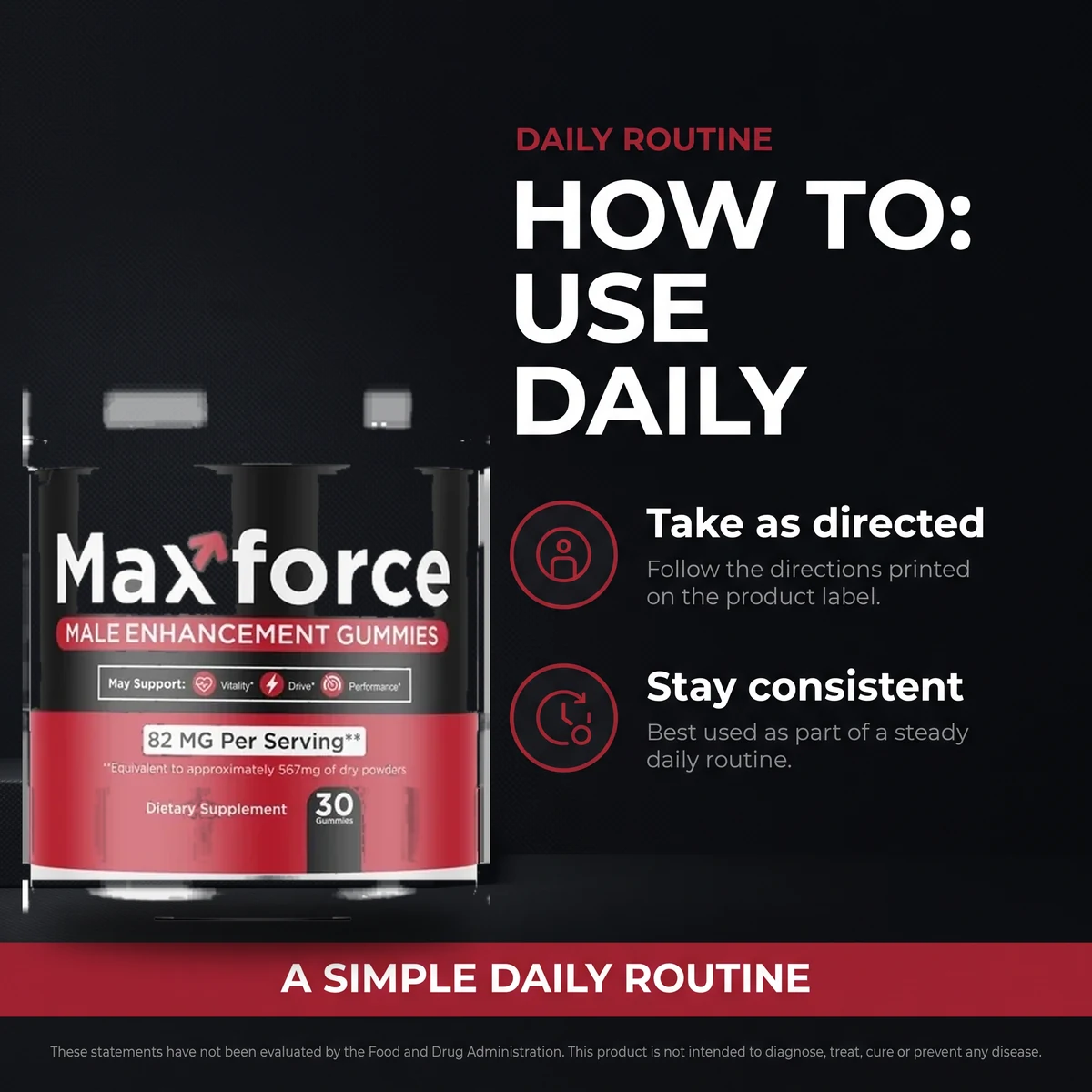
You can see the arithmetic on the product this site covers. The MaxForce jar states 82 mg per serving across five ingredients, footnoted as equivalent to approximately 567 mg of dry powders before concentration. That is an ordinary figure for a five-ingredient gummy, and it is far smaller than the amounts used in the trials people cite: the ashwagandha stress studies typically used a few hundred milligrams of concentrated root extract daily, and the maca desire trials used gram-scale amounts. The details for those two botanicals are in what the maca and ashwagandha trials actually found.
Which supplement form suits which buyer?
| Gummy | Capsule | Tablet | Liquid drops | |
|---|---|---|---|---|
| Room for active ingredient | Lowest — tens of mg | High — hundreds of mg | Highest | Moderate, dilution-dependent |
| What else you swallow | Sugar or sugar alcohol, pectin or gelatin, colour, flavour | Shell plus a flow agent | Binders and coating | Glycerine, alcohol or oil |
| Ease of taking every day | Best | Poor if you dislike pills | Poorest at large sizes | Good, if the taste suits you |
| Dose consistency per serving | Hardest to control in manufacture | Easiest | Easiest | Depends on your measuring |
| Suits a low-sugar diet | Check the sugar line first | Usually yes | Usually yes | Usually yes |
Nothing in that table is a claim about whether the ingredients work; it compares containers. Whether the contents do anything is answered separately in do testosterone boosters actually work.
Does the dosage form change how much you absorb?
For the ingredients used in men’s vitality formulas, there is no reliable human evidence that it does. The idea that chewing improves absorption is borrowed from a few nutrients where formulation genuinely matters — fat-soluble vitamins taken with oil — and then applied to botanicals where nobody has tested it. Language such as “faster absorption” on a gummy jar is an assertion rather than a measurement.
A gummy begins dissolving sooner, which changes the first few minutes of the journey rather than the total that crosses the gut wall. If a supplement is going to do anything, the timescale is set by the ingredient and not the wrapper, which is why the answer to how long a men’s supplement takes to work is the same eight to twelve weeks whatever form you bought.
How accurate are the amounts printed on a gummy label?
Less accurate than the printing implies, because gummies are a harder manufacturing problem than capsules: active material has to be spread evenly through warm liquid confectionery before it is deposited into moulds, and any settling or heat degradation shows up as variation between pieces. When researchers assayed melatonin gummies sold in the United States, most products did not match their labels and one contained no detectable melatonin at all (Cohen et al., JAMA, 2023). Melatonin is not a botanical blend, but the deposition problem is identical.
The practical consequence is that a printed milligram figure on a gummy is a target rather than a guarantee, and a blended figure such as 82 mg across five ingredients cannot be checked at all without a per-ingredient breakdown.
What the evidence shows, and what it does not
What it shows. Swallowing difficulty is common enough to change adherence in a measurable minority of adults, so dosage form is a genuine variable — though people do not automatically prefer the softer option. Gummy manufacturing produces documented label-to-content discrepancies.
What it does not show. That any form improves absorption of these botanicals in humans, that a gummy reproduces a trial’s capsule dose, or that the form changes what the ingredients can do. On that last point the systematic reviews are blunt: most ingredients marketed in testosterone-boosting products have no human evidence of raising testosterone at all (Morgado et al., Int J Impot Res, 2024).
The safety problem that no dosage form fixes
Choosing a gummy over a capsule does nothing about the largest documented risk in this category, which is undeclared prescription drugs. An analysis of a decade of US Food and Drug Administration warnings identified 776 adulterated dietary supplements, of which sexual-enhancement products were the largest group at 45.5%, sildenafil being the commonest hidden ingredient (Tucker et al., JAMA Netw Open, 2018). A laboratory survey of 20 food supplements sold for erectile dysfunction found undeclared ingredients in 14, with sildenafil in 12, sometimes above the maximum recommended dose of the medicine itself (Petkova-Gueorguieva et al., Int J Anal Chem, 2022). A multidisciplinary review called drug-adulterated sexual enhancement supplements a worldwide public health threat (Yéléhé-Okouma et al., Fundam Clin Pharmacol, 2021).
Every one of those products came in some dosage form or other, and the form told the buyer nothing. Buying from the seller’s own store rather than an anonymous marketplace listing is the practical defence, and the checks worth doing first are in the men’s supplement safety checklist.
Is a brand sold as “pills” the same product as the gummy version?
Not automatically, and this trips people up constantly. Search results routinely mix a brand’s gummy with capsules, tablets and drops carrying a similar name, and there is no rule that a company sells one formula in several shapes. Open the seller’s own page and compare what the jar is actually labelled with the listing in front of you. MaxForce is a worked example: it is sold as gummies only, the jar is labelled MALE ENHANCEMENT GUMMIES, and it holds 30 gummies at a stated 82 mg per serving, so anything sold as MaxForce pills, capsules or drops is not the product on the official product page. What can and cannot be checked about a product like this is set out in what customer feedback can actually verify, and the buying side in where to buy and what it costs per day.
Three mistakes people make when choosing a supplement form
- Assuming a gummy is gentler. The base is gentler; the botanicals are identical. Ashwagandha interacts with thyroid medication and sedatives in a gummy exactly as it does in a capsule.
- Doubling up across products. A gummy multivitamin plus a gummy men’s formula can quietly duplicate the same botanical, which is the overlap problem set out in the guide to stacking men’s supplements.
- Treating the form as evidence. A modern format is a packaging decision, and it says nothing about whether anything inside has been tested — the question examined in what the tongkat ali research actually shows.
We earn a commission if you buy through the links on this site. That is why this page carries no rating and no testimonials, and why the research cited here concerns dosage forms and label accuracy rather than the finished product.
How to choose the form you will actually keep taking
- Start with the swallow. If you have ever given up on a capsule, buy the gummy and stop optimising: adherence beats a better dose you never take.
- Check the total, then look for the split. If the milligram figure is not broken out by ingredient, accept that you cannot compare it with any published trial.
- Read the “other ingredients” line, where the sugar, the gelling agent, the colours and any allergen live, and price the purchase per day rather than per jar.
- Set a window and a stop rule before you order, and take the ingredient list to a pharmacist if you use any prescription medication, especially for blood pressure, thyroid function or sedation.
And if what prompted the search was a symptom rather than a product, the form question is beside the point — start with the symptoms that warrant a blood test instead.
Frequently asked questions
Are gummy supplements as good as capsules?
For the same ingredient at the same amount, there is no good human evidence that a gummy works better or worse than a capsule. The real differences are practical: a gummy holds less active material and carries a sugar base, while a capsule holds more but is harder for some people to swallow.
Do gummies contain smaller doses than pills?
Usually, yes. A gummy is mostly gelling agent, sweetener and flavour, so the space left for active ingredients is small: often tens of milligrams rather than the hundreds a capsule can carry. That matters when a published trial used a gram-scale dose, because a gummy will rarely reach it.
Is a product sold as pills the same as the gummy version?
Not necessarily. Different forms of a brand can differ in ingredients, amounts and even in who makes them. MaxForce is sold as gummies only: the jar is labelled MALE ENHANCEMENT GUMMIES and holds 30 gummies, so anything advertised as MaxForce pills, capsules or drops is not the product on the official website.
How accurate are the amounts printed on a gummy label?
Less reliably than most buyers assume. When researchers assayed melatonin gummies sold in the United States, the measured content of most products differed substantially from the declared amount, and one contained no detectable melatonin at all. That is a different category of gummy but the same manufacturing problem.
Check the current MaxForce label, price and guarantee
MaxForce is sold as gummies only. Contents, price, shipping and the 60-day return window are set by the seller and can change without notice, so confirm them on the official order page before you buy.
Check Seller TermsReferences
- Fields J, Go JT, Schulze KS. Pill properties that cause dysphagia and treatment failure. Curr Ther Res Clin Exp. 2015. PubMed: 26543509
- Rothen JP, Rutishauser J, Walter PN, Hersberger KE, Arnet I. Oral intermittent vitamin D substitution: influence of pharmaceutical form and dosage frequency on medication adherence. BMC Pharmacol Toxicol. 2020. PubMed: 32653031
- Cohen PA, Avula B, Wang YH, Katragunta K, Khan I. Quantity of melatonin and CBD in melatonin gummies sold in the US. JAMA. 2023. PubMed: 37097362
- Morgado A, et al. Do “testosterone boosters” really increase serum total testosterone? A systematic review. Int J Impot Res. 2024. PubMed: 37697053
- Tucker J, Fischer T, Upjohn L, Mazzera D, Kumar M. Unapproved pharmaceutical ingredients included in dietary supplements associated with US Food and Drug Administration warnings. JAMA Netw Open. 2018. PubMed: 30646238
- Petkova-Gueorguieva E, Gueorguiev S, Lebanova H, Madzharov V, Mihaylova A. Survey on sildenafil, tadalafil, and vardenafil concentrations in food supplements for erectile dysfunction. Int J Anal Chem. 2022. PubMed: 35855809
- Yéléhé-Okouma M, et al. Drug adulteration of sexual enhancement supplements: a worldwide insidious public health threat. Fundam Clin Pharmacol. 2021. PubMed: 33484004
These references cover dosage forms, label accuracy and supplement adulteration generally. None tested the finished MaxForce gummy, which has no published trial of its own.