How long does a men’s vitality supplement take to work?
Quick answer
Judge a botanical men’s vitality supplement over eight to twelve weeks of consistent daily use, because that is the window the underlying trials used. Ashwagandha’s stress and sleep studies typically ran 60 days or longer; the most-cited maca trial measured desire at weeks eight and twelve. Nothing in this category has evidence for a first-week effect.
“How long before it works” has a defensible answer, and it comes from the length of the trials rather than from a marketing promise. Here is where the eight-to-twelve-week figure comes from and what to do while you wait.
Where the eight-to-twelve-week window comes from
It is not a rule of thumb. It is the design of the studies. The most-cited ashwagandha stress trial ran for 60 days before its final measurement (Chandrasekhar et al., Indian J Psychol Med, 2012). The crossover study looking at hormones and vitality in aging, overweight men used eight-week treatment periods (Lopresti et al., Am J Mens Health, 2019). The maca trial that reported improved self-reported desire measured it at weeks eight and twelve, with no effect at week four (Gonzales et al., Andrologia, 2002). Meta-analyses of ashwagandha and sleep pool trials of broadly that length (Cheah et al., PLoS One, 2021).
If the researchers needed two to three months to detect a difference against placebo with standardised extracts and validated questionnaires, a consumer noticing nothing after ten days has learned nothing at all.
Why botanicals are slow
Adaptogens are studied for their effect on the stress response, which is a system that adjusts rather than a switch that flips. Perceived stress and sleep quality improve gradually because they are downstream of habit, recovery and accumulated fatigue. There is no acute pharmacological event to notice on day one — and a product that does produce one is doing something its ingredient list does not explain.
What a realistic timeline looks like
| Point | What is reasonable to expect |
|---|---|
| Days 1–7 | Nothing attributable. You are building the habit, not measuring an effect. |
| Weeks 2–4 | Still too early. Any change here is as likely to be sleep, weather or expectation. |
| Weeks 4–8 | The earliest point at which trials began detecting differences on stress and sleep measures. |
| Weeks 8–12 | The window the evidence actually covers. Judge here. |
| Beyond 12 weeks | Largely unstudied for these ingredients. Reassess rather than continue by default. |
What that means for how much to buy
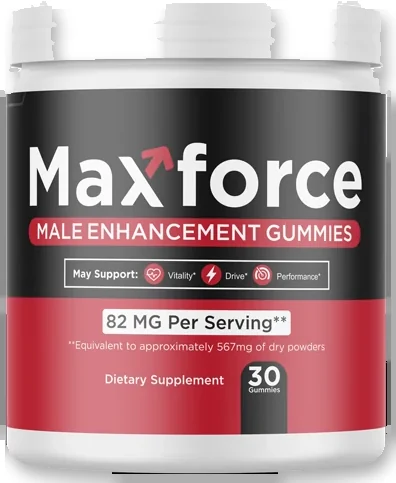
It is the reason bundle sizes in this category map onto months rather than weeks. A jar of MaxForce holds 30 gummies, and the seller’s package arithmetic — 2 jars for 60 days, 3 for 90, 6 for 180 — points to one gummy daily. The visible seller page did not state an explicit daily direction, so the directions printed on your own jar are the ones to follow. A two-jar supply covers the eight-week minimum; a three-jar supply covers the twelve-week window the trials describe. The cost arithmetic for each is in where to buy and what it costs.
The four things that make a slow supplement look like a fast one
Regression to the mean. Men buy supplements at their worst week. The following weeks are statistically likely to be better whatever they do, and the jar gets the credit.
The habit itself. Deciding to take something daily usually arrives bundled with an earlier bedtime, more training and less drinking. Those have their own evidence, set out in the levers that actually move male hormones, and they act faster than any botanical here.
Expectation. Energy, drive and stress are self-reported and highly responsive to attention. That is why a placebo arm exists, and why a personal before-and-after is not evidence about a compound.
Something undeclared. An unmistakable same-day effect from a botanical formula matches the profile of products that have been found to contain undeclared pharmaceutical ingredients. Speed is not a quality signal in this category; it is a question.
How to actually judge it
- Write down a baseline before you start. Sleep quality, energy at 4pm, stress, drive — score each out of ten, today.
- Change one thing at a time. Starting a supplement, a training block and a diet in the same week means you will never know which did what.
- Take it at the same time daily. Adherence is the variable you control and the one most likely to decide the result.
- Re-score at week eight and week twelve. Compare to your written baseline, not to your memory of it.
- Set a stop rule in advance. If nothing has moved by week twelve, stop. Continuing out of sunk cost is how a fifty-dollar experiment becomes a five-hundred-dollar habit.
A refund window and an evidence window are different lengths. MaxForce states a 60-day money-back guarantee, while the trials behind its ingredients run eight to twelve weeks — so decide about the refund before the evidence window closes.
Does taking more speed it up?
No, and it is the wrong lever. Trial doses are chosen for the balance of effect and tolerability, not as a floor to exceed, and doubling a multi-ingredient gummy doubles the sugar base and every co-ingredient along with the one you were interested in. Since most labels in this category do not publish a per-ingredient split, you would also be increasing an unknown quantity of ashwagandha — the ingredient with the documented liver and thyroid case reports. Follow the directions on your own jar.
The lever that does matter is consistency. Every trial in this field measured a daily dose taken without gaps, so a jar taken four days out of seven for three months is not a twelve-week trial of anything. If you keep forgetting, fix the trigger rather than the dose: attach it to something you already do at the same time every day.
What should never take weeks
A safety problem. Rash, palpitations, severe headache, jaundice, dark urine or persistent abdominal pain are reasons to stop immediately regardless of how far into the plan you are, and to seek medical advice — see the safety and interaction checklist. And a symptom that needs investigating should not wait for a twelve-week supplement trial either: the symptom list that needs a doctor is short and worth reading before you start counting weeks.
What to record while you wait
An eight-to-twelve-week window is only useful if something is being measured across it, and memory is a poor instrument for exactly the outcomes at stake here. Before the first dose, write down three things and a date, then leave them alone.
- One outcome you actually care about, phrased so a stranger could score it — not “more energy” but “awake without coffee before ten”.
- A baseline number. Hours slept, sessions trained, or a simple nought-to-ten rating recorded on the same day each week.
- Everything else that changed. New job, new training block, a holiday, a course of antibiotics. These are what usually explain a result.
- A decision date, set before you start and ideally inside the refund window rather than after it.
What the evidence shows, and what it does not
What it shows. The human trials behind the botanicals in this category almost all ran for eight to twelve weeks before measuring anything, which is where the window comes from. Nothing about that timescale is a marketing convention.
What it does not show. That any of those trials tested the finished product you have bought, that a gummy delivers the amount the trial used, or that waiting the full twelve weeks produces a result at the end of it. If the timeline you are picturing is measured in hours rather than months, what you have in mind is a pharmaceutical effect rather than a nutritional one, and the difference between the two categories is set out in natural boosters versus TRT.
Frequently asked questions
How long does a testosterone booster take to work?
Judge it over eight to twelve weeks of consistent daily use. That is the window the underlying trials used: the most-cited ashwagandha stress trial ran 60 days, and the maca desire trial measured effects at weeks eight and twelve with nothing at week four.
Should I feel something in the first week?
No, and a product that produces a strong same-day effect from a botanical ingredient list is doing something the label does not explain. Botanical support acts on systems that adjust gradually, which is why the trials needed two to three months to detect a difference.
How many jars do I need to give it a fair trial?
At one gummy a day from a 30-gummy jar, two jars covers the eight-week minimum and three jars covers the full twelve-week window the trials describe. Follow the directions printed on your own jar rather than package arithmetic.
When should I stop rather than keep going?
Set the rule before you start: if nothing has moved against your written baseline by week twelve, stop. Stop immediately, regardless of timing, for rash, palpitations, severe headache, jaundice, dark urine or persistent abdominal pain.
Check the current MaxForce label, price and guarantee
Package contents, price, shipping and the 60-day return window are set by the seller and can change without notice. Confirm them on the official order page before you buy.
Check Seller TermsReferences
- Chandrasekhar K, Kapoor J, Anishetty S. A prospective, randomized double-blind, placebo-controlled study of safety and efficacy of a high-concentration full-spectrum extract of ashwagandha root in reducing stress and anxiety in adults. Indian J Psychol Med. 2012. PubMed: 23439798
- Lopresti AL, Drummond PD, Smith SJ. A randomized, double-blind, placebo-controlled, crossover study examining the hormonal and vitality effects of ashwagandha (Withania somnifera) in aging, overweight males. Am J Mens Health. 2019. PubMed: 30854916
- Gonzales GF, et al. Effect of Lepidium meyenii (MACA) on sexual desire and its absent relationship with serum testosterone levels in adult healthy men. Andrologia. 2002. PubMed: 12472620
- Cheah KL, Norhayati MN, Husniati Yaacob L, Abdul Rahman R. Effect of Ashwagandha (Withania somnifera) extract on sleep: a systematic review and meta-analysis. PLoS One. 2021. PubMed: 34559859
These references cover individual ingredients and men’s health generally. None tested the finished MaxForce gummy, which has no published trial of its own.