Men’s vitality supplements: what the label must tell you
Quick answer
A men’s vitality supplement label should tell you five things before you buy: every ingredient by name, how much of each you get per serving, whether that figure is extract or raw herb, how many servings are in the container, and who to contact for a refund. A label that hides any of those behind a blend name is asking you to buy on trust rather than on information.
Men’s vitality supplements are one of the least transparent shelves in the supplement aisle. This guide is about the part you can actually inspect — the label — and what each line on it does and does not prove.
What counts as a men’s vitality supplement?
A men’s vitality supplement is a dietary supplement marketed to support energy, drive and everyday performance in adult men, usually built from botanicals such as maca, ashwagandha, tongkat ali, horny goat weed or fenugreek, sometimes with an amino acid such as L-arginine and often with zinc, magnesium or vitamin D added. Legally it sits in the same category as a multivitamin. It is not a medicine, it is not approved by the FDA before sale, and it cannot be sold as a treatment for erectile dysfunction, low testosterone or infertility.
That legal position is why labels here read the way they do: a structure/function statement such as “supports drive” carries an asterisk pointing at the standard FDA disclaimer, and a disease claim is not permitted at all. A page promising what a medicine would promise has moved past what its own label is allowed to say.
The five things a label must tell you
Everything useful on a supplement container sits in one panel. Read it in this order.
- The complete ingredient list, by name. Not “proprietary male blend” — the actual botanical or compound names.
- The amount per serving. Either per ingredient or, at minimum, a total for the blend.
- Whether the figure is extract or raw powder. These are different by an order of magnitude and are routinely conflated in marketing.
- Servings per container and the serving size. This is how you turn a price into a cost per day.
- Other ingredients, allergens and a contact route. The gummy base, the colours, the sweetener, and a real support address.
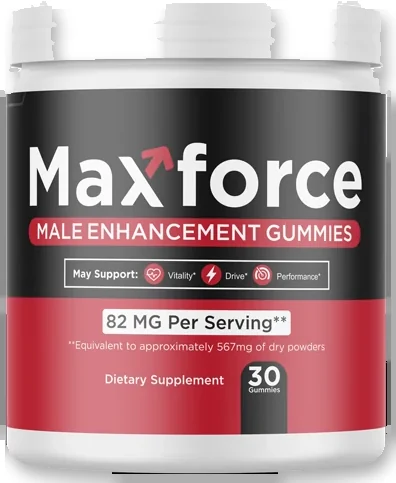
The MaxForce label is a workable example of the middle case: five named ingredients — muira puama extract, maca extract, catuaba extract, ashwagandha and L-arginine — and 82 mg per serving, footnoted as equivalent to approximately 567 mg of dry powders. Naming the ingredients and printing a number is more than many competitors manage. Not publishing the per-ingredient split withholds the one figure you would need to compare it against any published trial.
Named ingredients versus a proprietary blend
A proprietary blend is a legal device that lets a manufacturer list ingredients in descending order of weight while disclosing only the combined total. It protects a formula from being copied. It also makes the product impossible to check against the research, because the research is always dose-specific: an ashwagandha trial that used 300 mg of a standardised root extract twice a day tells you nothing about a product that might contain 15 mg of ashwagandha inside a 500 mg blend.
When researchers went looking at the actual contents of this category, the picture was not flattering. An analysis of the best-selling online testosterone-boosting supplements found that only a minority of the listed ingredients had any human data suggesting they raise testosterone, while some products supplied vitamins and minerals in amounts above the recommended upper intake levels (Balasubramanian et al., J Sex Med, 2019). A later systematic review asking the same question — do these products actually raise serum total testosterone — reached a similarly deflating answer for most of the ingredients involved (Morgado et al., Int J Impot Res, 2024). None of that makes a named-ingredient label good on its own. It makes an unnamed one indefensible.
Why an extract figure needs its footnote
Botanical extracts are concentrated. A 10:1 extract means ten parts of dried herb were reduced to one part of extract, so 82 mg of extract may be described as “equivalent to” several hundred milligrams of raw powder. Both numbers are true and they measure different things. The mistake to avoid is reading the larger, herb-equivalent number as the amount in the product, or comparing a raw-powder dose from a trial with an extract dose on a label as though they were the same unit.
Two labels are comparable only when you know the plant part, the extraction ratio or standardisation marker, and the amount. Miss one and you are comparing marketing copy.
Label claim versus what it actually means
| What the label says | What it establishes | What it does not |
|---|---|---|
| “Clinically studied ingredients” | Some ingredient in the formula has appeared in a study somewhere | That this product, at this dose, was studied |
| “Doctor formulated” | A clinician was involved in choosing the ingredients | That the finished product was tested or reviewed independently |
| “GMP certified facility” | The manufacturing site follows documented quality procedures | Anything at all about whether the formula works |
| “Made in the USA” | Final manufacture or assembly happened domestically | That the botanicals were grown or extracted domestically |
| “All natural” | Nothing, in regulatory terms | Safety, potency, or freedom from interactions |
| “82 mg per serving” | The total weight of active material you swallow | How that total is split between five ingredients |
What the evidence behind the common ingredients looks like
The ingredients in this category do not all sit at the same level of evidence, and a good label lets you sort them. Ashwagandha has the largest controlled human literature, mostly on stress, anxiety and sleep rather than on hormones (Cheah et al., PLoS One, 2021). Maca has a handful of small randomised trials on self-reported desire, reviewed and found methodologically limited (Shin et al., BMC Complement Altern Med, 2010). Amazonian barks such as catuaba and muira puama sit almost entirely on traditional use and preclinical work (Teixeira et al., J Ethnopharmacol, 2024). If you want the detail on the two best-studied of those, our guide to what the maca and ashwagandha trials actually measured goes through them one trial at a time, and the separate piece on L-arginine and the nitric-oxide pathway covers the one non-botanical ingredient most of these formulas share.
What a label can never tell you
A label is a manufacturing document, not an outcome. It cannot tell you whether the product will do anything for you, how quickly, or whether your symptom has a cause that a supplement is irrelevant to. Persistently low drive, fatigue and difficulty with erections are also the presentation of thyroid disease, depression, sleep apnoea, diabetes and cardiovascular disease, and erectile difficulty in particular is recognised as an early cardiovascular warning sign (Corona et al., Expert Rev Cardiovasc Ther, 2020). Before you spend money on a jar, read the symptoms that should send you to a doctor rather than to a supplement shelf.
A supplement label is not a diagnosis and this guide is not medical advice. If you take prescription medication — particularly nitrates, blood-pressure medicine, sedatives, thyroid medication or anticoagulants — hand the ingredient list to your doctor or pharmacist before you start.
Gummies, capsules and drops: does format change the label?
Format changes what else is in the container. A gummy carries a sugar or sugar-alcohol base, gelling agents, colours and flavours, which is why the “other ingredients” line matters more on a gummy than on a capsule. It also changes how carefully the manufacturer has to control dose uniformity: when researchers assayed melatonin gummies sold in the US, the actual content of most products differed substantially from the declared amount (Cohen et al., JAMA, 2023). That study was not about vitality products, but the lesson generalises — a gummy is a harder dosage form to keep consistent than a pressed tablet. The format trade-offs are set out in full in our explainer on what male enhancement gummies are and how they differ from capsules, and the form-by-form comparison — including why a gummy cannot carry a capsule’s dose — is in gummies versus capsules versus pills.
Three mistakes men make comparing two labels
Counting ingredients instead of weighing them. A twenty-ingredient formula is usually twenty token amounts; a five-ingredient formula with a printed total is easier to check and easier to hand a pharmacist.
Comparing price per container instead of price per day. Divide the total by servings per container, then by servings per day. A jar of 30 gummies taken once daily is a 30-day supply; a 60-count bottle taken twice daily is the same 30 days at a different headline price.
Treating a guarantee as a quality signal. A refund window describes the seller’s returns policy, not the formula — the mechanics of those windows are covered in where to buy a men’s vitality supplement and what it really costs.
A five-minute label check
- Photograph the Supplement Facts panel, front and back.
- Write down each ingredient with its amount. If an amount is missing, mark it unknown rather than assuming it is adequate.
- Note whether each figure is extract or raw herb, and any standardisation marker.
- Divide the price by servings to get a cost per day.
- Check the “other ingredients” line against your allergies and, if you are diabetic, against the sugar content of a gummy base.
- Search each ingredient name plus “randomised trial” before deciding the label is impressive.
For a worked version of that process applied to an actual shortlist, see how to choose between two men’s vitality formulas.
Frequently asked questions
What should a men's vitality supplement label always show?
It should show every ingredient by name, the amount of each per serving or at minimum a blend total, whether those figures are extract or raw herb, the serving size and servings per container, the other ingredients and allergens, and a contact route for support and refunds. Anything missing from that list is information you are being asked to take on trust.
Is a proprietary blend automatically a red flag?
It is not automatically dishonest, but it makes the product impossible to check against published research, because research findings are dose-specific. If a formula hides behind a blend total you cannot tell whether any ingredient reaches an amount that has ever been studied.
What does 82 mg per serving equivalent to 567 mg of dry powders mean?
It means the gummy contains 82 mg of concentrated botanical extract, and that extract was produced from roughly 567 mg of dried plant material. Both figures are true and they measure different things. The 82 mg figure is what you swallow; the 567 mg figure describes the starting material.
Does a GMP certificate mean the supplement works?
No. Good Manufacturing Practice certification describes how the facility is run: documented procedures, cleaning, record keeping and batch control. It says nothing about whether the formula has any effect, and dietary supplements are not FDA-approved before sale.
Check the current MaxForce label, price and guarantee
Package contents, price, shipping and the 60-day return window are set by the seller and can change without notice. Confirm them on the official order page before you buy.
Check Seller TermsReferences
- Balasubramanian A, et al. Testosterone imposters: an analysis of popular online testosterone boosting supplements. J Sex Med. 2019. PubMed: 30770069
- Morgado A, et al. Do “testosterone boosters” really increase serum total testosterone? A systematic review. Int J Impot Res. 2024. PubMed: 37697053
- Cheah KL, Norhayati MN, Husniati Yaacob L, Abdul Rahman R. Effect of Ashwagandha (Withania somnifera) extract on sleep: a systematic review and meta-analysis. PLoS One. 2021. PubMed: 34559859
- Shin BC, Lee MS, Yang EJ, Lim HS, Ernst E. Maca (L. meyenii) for improving sexual function: a systematic review. BMC Complement Altern Med. 2010. PubMed: 20691074
- Teixeira TM, et al. The traditional use of native Brazilian plants for male sexual dysfunction: evidence from ethnomedicinal applications, animal models, and possible mechanisms of action. J Ethnopharmacol. 2024. PubMed: 37437795
- Corona G, Rastrelli G, Sparano C, Vignozzi L, Maggi M. Erectile dysfunction and cardiovascular risk: a review of current findings. Expert Rev Cardiovasc Ther. 2020. PubMed: 32192361
- Cohen PA, Avula B, Wang YH, Katragunta K, Khan I. Quantity of melatonin and CBD in melatonin gummies sold in the US. JAMA. 2023. PubMed: 37097362
These references cover individual ingredients and men’s health generally. None tested the finished MaxForce gummy, which has no published trial of its own.