Muira puama and catuaba: what the human trial evidence actually shows
Quick answer
Muira puama and catuaba are two of the five ingredients MaxForce's own ingredients page names, and they are the two with the thinnest human evidence of the five — the site's own ingredient card for each says so directly. A PubMed search turns up no placebo-controlled trial that tested either ingredient by itself in humans. Both appear in a handful of human studies as part of multi-herb combination products, and those studies mostly measured safety and tolerability, not effectiveness.
Maca and ashwagandha get most of the research attention in a formula like this one. Muira puama and catuaba get almost none. This is what actually exists in the PubMed-indexed literature for both, study by study, so you can see exactly what "limited evidence" means in practice rather than taking anyone's word for it.
What muira puama and catuaba are
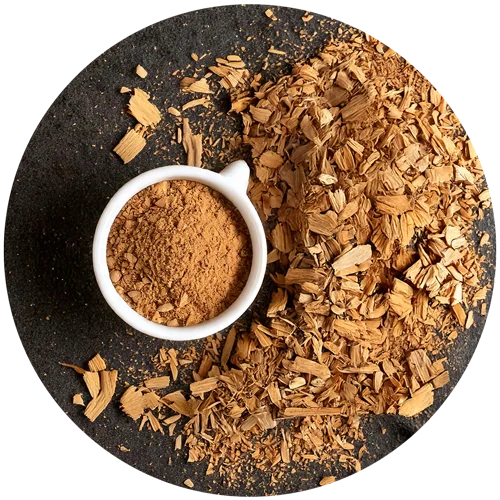
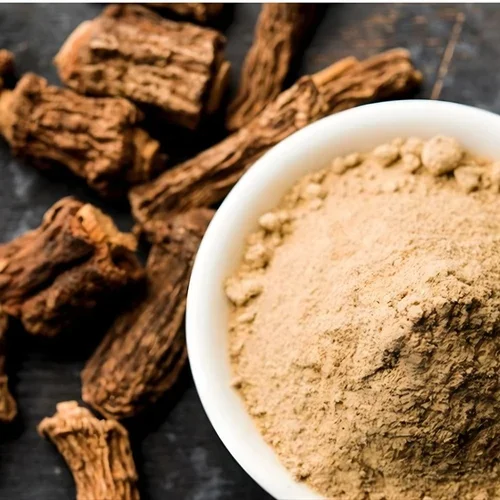
Muira puama (Ptychopetalum olacoides) is a shrub native to the Brazilian Amazon whose bark and root have a long history in regional herbal medicine, where it is sometimes called "potency wood." Catuaba is a common name applied to bark from several different Brazilian plant species, most often Trichilia catigua in the products sold in North America and Europe; it carries a similarly long history as a traditional men's tonic ingredient. Both are named on the MaxForce ingredients page among the product's five listed botanicals and amino acid, alongside maca, ashwagandha and L-arginine.
What a PubMed search for each ingredient actually returns
A search of PubMed for "Ptychopetalum olacoides" and human-relevant terms returns work that is almost entirely preclinical — antioxidant assays, animal behavior studies and ethnobotanical surveys — rather than trials in people. A parallel search for "Trichilia catigua" returns the same pattern: laboratory and animal work, with human data appearing only inside combination-product studies. Neither search turns up a randomized, placebo-controlled trial that isolated muira puama or catuaba as the single tested ingredient in a human sexual-health or vitality outcome. That absence is the finding, and it matches what MaxForce's own ingredient card for each botanical already states about limited human evidence.
The one human safety study that actually names both ingredients
The most directly relevant human study is a 2005 clinical toxicology paper published in Phytotherapy Research. Researchers gave healthy adult volunteers a proprietary four-herb combination called Catuama — containing Paullinia cupana (guarana), Trichilia catigua (catuaba), Ptychopetalum olacoides (muira puama) and ginger — and monitored blood chemistry, vital signs and adverse events (Oliveira et al., Phytother Res, 2005). The product was reported as well tolerated. This is a real, PubMed-indexed human study that names both catuaba and muira puama. It is worth being precise about what it is: a safety and tolerability study of a four-herb blend at whatever dose that specific product used, not an efficacy trial, and not a test of either ingredient in isolation. It tells you the combination did not cause obvious harm in that sample over that period — it does not tell you what muira puama or catuaba does on its own.
The pilot study that includes muira puama alongside three other ingredients
A second human study worth naming appeared in 2018 in Translational Andrology and Urology. Fifty-four middle-aged men with erectile dysfunction were given a nutraceutical called Revactin twice daily — a combination of ginger root, muira puama, guarana (Paullinia cupana) and L-citrulline — and completed the IIEF-15 questionnaire at baseline and at one, two and three months (Nguyen et al., Transl Androl Urol, 2018). The paper reports that median domain scores for erectile function, orgasmic function, sexual desire and overall satisfaction increased over the three months compared to baseline, with a favorable safety profile and no serious adverse events. Read the design carefully before drawing any conclusion from it: this was described by the authors as a pilot safety study, participants were not randomized against a placebo arm in the portion measuring outcomes, and more than a third of the original group had dropped out by month three (32 of 54 remained at month one, falling to 16 by month three). A single-arm study with no placebo comparison and substantial attrition cannot separate a real drug effect from a placebo response, a practice effect on the questionnaire, or the natural ebb and flow of erectile symptoms over twelve weeks. It is evidence that the blend was reasonably well tolerated in this small group. It is not proof that muira puama, or the blend as a whole, caused the score changes.
What the ethnobotanical literature adds
Two further PubMed-indexed papers are worth knowing about, though neither is a clinical trial. A 2007 survey of Brazilian plants used as adaptogens, drawn from books published in Brazil, lists muira puama among traditionally used tonics without presenting new trial data (Chan, Houghton & Kartal reviewers cited in Calixto-review context, J Ethnopharmacol, 2007), and a 2003 review of plant-derived approaches to sexual dysfunction in the Journal of Sex & Marital Therapy discusses muira puama and catuaba as examples of traditionally used botanicals with limited controlled human data available at the time of writing (Ernst, J Sex Marital Ther, 2003). Reviews summarize what other researchers found; they do not add new evidence of their own. Both are cited here because they are the kind of source that keeps surfacing when this specific claim is checked, and both say the same thing MaxForce's own ingredient card says: traditional use, thin controlled evidence.
Side by side
| Muira Puama | Catuaba | |
|---|---|---|
| Dedicated human RCT of the single ingredient | None found in PubMed | None found in PubMed |
| Human data that exists | Uncontrolled pilot (4-ingredient blend, ED); tolerability study (4-herb blend) | Tolerability study (4-herb blend) |
| What that data measured | Safety, IIEF-15 scores in an uncontrolled pilot | Safety and tolerability only |
| Non-human evidence | Animal behavior studies, in vitro antioxidant assays | Animal and in vitro studies |
| MaxForce label dose | Not published individually (82 mg combined across 5 ingredients) | Not published individually (82 mg combined across 5 ingredients) |
Why the dose gap matters even if a trial existed
This is worth stating even though it does not change the headline finding: MaxForce's own ingredients page discloses a combined 82 mg per serving across muira puama, maca, catuaba, ashwagandha and L-arginine, footnoted as equivalent to approximately 567 mg of dry powders, with no individual milligram figure for any single ingredient published on the pages we reviewed. So even in a hypothetical world where a rigorous single-ingredient trial existed for muira puama or catuaba, there would be no published per-ingredient amount in the MaxForce gummy to compare it against. The label itself says as much on its ingredients section, and this article is not going to guess a split it does not have.
How "limited evidence" gets misread on a supplement label
There is a specific way marketing language exploits the gap between traditional use and controlled evidence. A page can truthfully say muira puama has "centuries of traditional use" or is "long valued in Amazonian herbalism," and every word of that can be accurate, while the reader comes away believing something closer to "clinically proven." Traditional use tells you a plant was consumed by people over a long period without the kind of catastrophic, immediately obvious harm that would have ended the practice. It does not tell you the plant reliably produces a specific measurable effect, at what dose, or how it compares with placebo — the three questions a controlled trial is built to answer. MaxForce's own ingredients section keeps these two claims separate rather than blurring them, describing muira puama and catuaba honestly as ingredients whose "human trial evidence is thin" and whose "controlled human evidence is limited," which is the same conclusion this closer PubMed search reaches independently.
What consistent traditional use is, and is not, worth
It would be a mistake to read the absence of trial data as proof that muira puama and catuaba do nothing. Ethnobotanical surveys are a legitimate, if limited, form of evidence: when a plant has been used consistently, across generations, for a specific purpose, in a specific cultural context, that consistency is itself informative — it is simply a different, weaker kind of information than a randomized trial provides. The 2007 survey of Brazilian adaptogens referenced above documents exactly this kind of consistent traditional application for muira puama. What it cannot do is quantify an effect size, establish a safe or effective dose in modern extract form, or rule out that the traditional preparation (often a raw bark decoction) behaves differently from a modern standardized extract added to a gummy base at an undisclosed fraction of 82 mg. Both things can be true at once: the tradition is real, and the modern extract in a specific commercial product remains untested.
What this does and does not mean for MaxForce
It does not mean muira puama and catuaba do nothing; absence of trial evidence is not evidence of no effect, and both have centuries of traditional use behind them in Brazilian herbal medicine. It also does not mean either ingredient is dangerous; the one directly relevant human safety study found the combination well tolerated. What it does mean is that any specific effect attributed to muira puama or catuaba — a boost to desire, energy or performance — rests on tradition and preliminary combination-product data rather than on a controlled trial of the ingredient itself. That is a narrower evidentiary base than maca or ashwagandha carry in the same formula, and it is worth knowing which ingredient in a five-ingredient blend is carrying which kind of evidence before you decide how much weight to put on the label's support claims.
Frequently asked questions
Is there a human clinical trial on muira puama by itself?
No dedicated placebo-controlled trial of muira puama alone in humans turned up in a PubMed search. It has appeared in a small uncontrolled pilot study of a four-ingredient blend in men with erectile dysfunction, and in a tolerability study of a four-herb combination product, but not as a single tested ingredient.
Is there a human clinical trial on catuaba by itself?
No dedicated placebo-controlled efficacy trial of catuaba (Trichilia catigua) alone in humans turned up in a PubMed search. The only identified human study involving catuaba tested it as one of four ingredients in a combination product, and it measured safety and tolerability, not sexual or vitality outcomes.
What is the strongest human evidence for either ingredient?
A 2005 clinical toxicology study published in Phytotherapy Research gave healthy volunteers a four-herb combination containing catuaba, muira puama, guarana and ginger and found it well tolerated over the study period. That is a safety finding about a four-herb blend, not an efficacy finding about either ingredient on its own.
Does MaxForce say how much muira puama or catuaba is in a gummy?
No. The MaxForce label states a combined 82 mg per serving across five ingredients, equivalent to approximately 567 mg of dry powders, without a per-ingredient breakdown. Even if a trial existed for either ingredient at a specific dose, there is no published figure to compare it against.
Check the current MaxForce label, price and guarantee
Package contents, price, shipping and the 60-day return window are set by the seller and can change without notice. Confirm them on the official order page before you buy.
Order MaxForceReferences
- Oliveira CH, Moraes ME, Moraes MO, Bezerra FA, et al. Clinical toxicology study of an herbal medicinal extract of Paullinia cupana, Trichilia catigua, Ptychopetalum olacoides and Zingiber officinale (Catuama) in healthy volunteers. Phytother Res. 2005 Jan. PubMed: 15798997
- Nguyen S, Rajfer J, Shaheen M. Safety and efficacy of daily Revactin® in men with erectile dysfunction: a 3-month pilot study. Transl Androl Urol. 2018 Apr;7(2):266-273. PubMed: 29732286
- Brazilian plants as possible adaptogens: an ethnopharmacological survey of books edited in Brazil. J Ethnopharmacol. 2007 Feb 12. PubMed: 17030478
- Ernst E. A review of plant-derived and herbal approaches to the treatment of sexual dysfunctions. J Sex Marital Ther. 2003 May-Jun. PubMed: 12851124
These references cover the individual ingredients and combination products containing them. None tested the finished MaxForce gummy, which has no published trial of its own.