Inside one ashwagandha study: what it measured and what it didn't
Quick answer
Most supplement pages cite ashwagandha research in one line and move on. This article does the opposite: it walks through a single real, PubMed-indexed randomized controlled trial in detail — the design, the exact dose, the sample size, what it actually measured, what it found, and, just as importantly, everything it did not test. The study measured body weight, stress and quality-of-life scores in general adults over 24 weeks. It did not measure sexual health, did not use the MaxForce gummy, and did not test whatever amount of ashwagandha sits inside MaxForce's undisclosed 82 mg blend.
MaxForce's own ingredients page and this site's broader evidence-summary post cite ashwagandha research at a survey level — several studies, a general conclusion. This article does something narrower on purpose: one study, read closely, the way a clinician or a skeptical reader would read it before deciding what it does and does not tell them.
The study
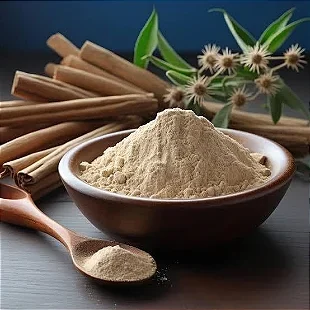
The trial is a prospective, randomized, double-blind, placebo-controlled study published in December 2025 in the Journal of Medicine and Life, run by researchers affiliated with a metabolic-syndrome clinic and a university school of medicine in Maharashtra, India (Pakhale et al., J Med Life, 2025). It enrolled 100 adults aged 19 to 65 and randomly assigned half to ashwagandha root extract (300 mg twice daily, 600 mg total per day) and half to an identical-looking placebo, for 24 weeks. Ninety-one participants completed enough of the study to be included in the efficacy analysis.
What it actually measured
The primary efficacy endpoints, stated up front in the design, were changes in body weight and body mass index (BMI). The secondary endpoints were: perceived stress, using the Perceived Stress Scale (PSS); quality of life, using the Short Form-12 Quality of Life Scale; subjective satisfaction, using a Subjective Satisfaction Scale; and food cravings, using the Food Cravings Questionnaire-Trait (FCQ-T). Safety was tracked through reported adverse events plus laboratory panels covering complete blood count, kidney function, liver function, lipid profile, thyroid function and glycemic markers. That is the full list. Nothing about sexual desire, erectile function, testosterone or "vitality" appears anywhere in the stated endpoints.
What it found
Over 24 weeks, the ashwagandha group lost significantly more weight than the placebo group: a mean reduction of 8.46 kg (roughly 18.7 lb) versus 2.41 kg on placebo, with a parallel drop in BMI of 3.31 versus 0.93 kg/m² (both comparisons reported as statistically significant, p < 0.0001). The ashwagandha group also showed significantly better scores than placebo on perceived stress, the quality-of-life scale, the satisfaction scale and the food-cravings questionnaire (p < 0.05 across those measures). Seven participants on ashwagandha reported treatment-related adverse events, which the trial as reported treated as broadly consistent with an acceptable safety profile at this dose over this period.
What it did not test — read this part before you extrapolate
This is the part a sales page skips, and it is the actual point of reading a single study closely instead of citing it in one line.
- It did not measure sexual health or vitality. The endpoints were weight, BMI, stress, quality of life, satisfaction and food cravings. There is no libido score, no erectile-function questionnaire, no testosterone measurement anywhere in the design. A trial that improved weight and stress scores is not evidence that the same extract improves drive or performance — those questions were never asked.
- It did not test this exact extract. The trial used a specific, named, standardized ashwagandha root extract from an identified supplier. MaxForce's own ingredients page names "ashwagandha" without stating which extract, which standardization, or which supplier is used in the gummy. Different ashwagandha extracts are prepared and standardized differently, and trial results for one extract do not automatically transfer to another.
- It did not test this dose. Participants took 600 mg of ashwagandha extract daily. MaxForce discloses a combined 82 mg per serving across all five named ingredients — muira puama, maca, catuaba, ashwagandha and L-arginine — with no individual ashwagandha figure published. Even under a generous assumption, an undisclosed share of an 82 mg total blend is very unlikely to approach 600 mg of a single standardized extract, though without a published split, no one outside the manufacturer can say the real number with certainty.
- It did not test the finished MaxForce gummy. It tested a capsule-form extract on its own. No published trial has tested the finished five-ingredient MaxForce gummy as a product.
- It did not test long-term use. Twenty-four weeks is a relatively long window for a supplement trial, and notably longer than the eight-to-twelve-week window seen in most ashwagandha studies — but it still says nothing about use beyond six months, which is where a genuine long-term safety or efficacy question would need to be answered by a different, longer study.
What "randomized, double-blind, placebo-controlled" actually bought this study
These design terms are not throat-clearing; each one rules out a specific way a supplement study can mislead. Randomized means participants were assigned to ashwagandha or placebo by chance rather than by choice, so the two groups should have started out roughly similar in age, weight and baseline stress rather than the ashwagandha group being, say, more motivated dieters to begin with. Double-blind means neither the participants nor the researchers measuring the outcomes knew who was taking the active extract, which removes the expectation effect that inflates results in open-label studies — the same expectation effect that likely inflated some of the numbers in the uncontrolled muira-puama pilot study covered elsewhere on this site. Placebo-controlled means there was a comparison group taking an inactive capsule rather than nothing at all, which controls for the fact that people who join any weight or stress study, take a daily pill and get regular attention from researchers tend to improve somewhat regardless of what is in the pill. All three design features together are why 8.46 kg of weight loss against a 2.41 kg placebo response is a meaningfully different and more trustworthy number than an uncontrolled before-and-after comparison would have produced.
What "statistically significant" does and does not tell you here
The p-values reported in this trial (p < 0.0001 for weight and BMI, p < 0.05 for the stress and quality-of-life measures) tell you the difference between the ashwagandha group and the placebo group was unlikely to be due to chance alone, given the sample size and the variation observed. They do not tell you the effect will be the same size in a different population, they do not tell you every individual in the ashwagandha group lost close to 8.46 kg (that figure is a group mean, and individual results in any such trial vary widely around it), and they do not tell you anything at all about outcomes the trial never measured, such as libido or erectile function. Statistical significance answers "is this probably a real effect in this study," not "does this apply to me, at this dose, for this purpose."
How a sales page could misuse this exact study
It is worth spelling out the mechanics of the misuse this article is trying to avoid, because it is common in this product category. A sales page could accurately write "a 2025 randomized, double-blind, placebo-controlled trial found ashwagandha produced significant improvements over placebo" — every word true — directly above or beside marketing copy about vitality, drive or performance, letting the reader's eye connect a real citation to an unrelated claim the citation never made. The citation is genuine. The implied connection to sexual health or energy is not something the study supports, because sexual health and energy were never on its list of endpoints. Spotting this pattern is straightforward once you know to look for it: check whether the outcome the citation actually measured matches the claim sitting next to it, not just whether the citation itself is real.
What a men's vitality trial of ashwagandha would actually need to look like
For comparison, a trial that could genuinely support a men's-vitality claim for ashwagandha would need to enroll adult men specifically, use a validated sexual-health or vitality questionnaire as a stated primary or secondary endpoint, disclose the exact extract and dose used, and ideally run for the eight-to-twelve-week minimum this literature generally treats as necessary to see an adaptogen effect. The Lopresti et al. 2019 crossover trial referenced on this site's broader evidence page comes closer to that description — it enrolled aging, overweight men and measured testosterone, DHEA-S, fatigue and vitality — but even that trial involved roughly twenty men and measured hormone and fatigue markers rather than a validated sexual-function questionnaire. The Pakhale et al. 2025 study examined in detail above is not that trial, and treating it as one would be a misreading of what it actually did.
Why this matters more than the topline result
The topline numbers in this trial — an 8.46 kg weight loss and improved stress scores over placebo — are a real, statistically significant finding about a specific extract at a specific dose in a general adult population being studied for weight and stress, not for men's vitality. Citing "a randomized controlled ashwagandha trial found significant benefits" without naming what it actually measured is technically true and functionally misleading if the reader assumes it means something about sexual health, energy or performance in a five-ingredient men's gummy. The gap between "this trial found X" and "therefore this unrelated product does X" is exactly where supplement marketing usually goes wrong, and it is why this article names the specific endpoints rather than paraphrasing them as a general "benefit."
How this differs from the site's other ashwagandha coverage
This site's broader evidence page surveys several ashwagandha and maca studies at once to give a general picture of what the ingredient category has and has not shown. This article deliberately does the opposite: one trial, read in full, with its exact numbers, its exact dose, and an explicit list of what it did not test. Both approaches are useful for different questions — the survey approach for "what does the overall evidence look like," and the single-study approach for understanding what any one citation actually entitles you to conclude.
Frequently asked questions
What study does this article walk through?
A 2025 randomized, double-blind, placebo-controlled trial published in the Journal of Medicine and Life. It gave 100 adults either 300 mg of ashwagandha root extract twice daily or a matching placebo for 24 weeks and measured body weight, BMI, perceived stress, quality of life, subjective satisfaction and food cravings.
Did the study test sexual health or vitality outcomes?
No. Its primary endpoints were body weight and BMI, and its secondary endpoints were the Perceived Stress Scale, a quality-of-life scale, a subjective satisfaction scale and a food-cravings questionnaire. It did not measure libido, erectile function, testosterone or any sexual-health outcome.
Did the study test the ashwagandha extract used in MaxForce?
There is no way to know. The trial used a named, standardized 300 mg-twice-daily root extract from a specific manufacturer. MaxForce's own label discloses only a combined 82 mg per serving across five ingredients, with no ashwagandha extract name, standardization or individual dose published, so no direct comparison is possible.
Did the study test the finished MaxForce gummy?
No. No published clinical trial has tested the finished MaxForce gummy. This and every other study referenced on this site examined an individual ingredient at a specific, disclosed dose, not the finished five-ingredient product.
Check the current MaxForce label, price and guarantee
Package contents, price, shipping and the 60-day return window are set by the seller and can change without notice. Confirm them on the official order page before you buy.
Order MaxForceReferences
- Pakhale K, Pakhale R, Srivathsan M, Langade J, Langade D. Efficacy and safety of Ashwagandha (Withania somnifera) root extract on stress and weight management in adults: a prospective, randomized, double-blind, placebo-controlled study. J Med Life. 2025 Dec;18(12):1140-1154. PubMed: 41635453
This reference covers a single ashwagandha extract at a specific, disclosed dose in a general adult weight-and-stress study. It did not test the finished MaxForce gummy, which has no published trial of its own and does not publish an individual ashwagandha dose.