Ashwagandha in a blend: who should not take it
Quick answer
Ashwagandha, one of the five ingredients named on the MaxForce label, is not a neutral botanical. Randomized, placebo-controlled trials have measured real changes in thyroid hormones and blood-pressure-related markers, and a published case report documents thyrotoxicosis in a previously healthy man after two months of use. Anyone with thyroid disease, anyone on thyroid medication, anyone with blood pressure that is already being medically managed, and anyone who is pregnant or breastfeeding should talk to a doctor before starting a product that contains it — which is also what MaxForce's own site copy says.
This is a narrower, more specific companion to a general safety page: not "is ashwagandha safe" in the abstract, but which two documented interaction profiles — thyroid and blood pressure — matter most, what the actual trial and case-report evidence for each looks like, and why a combined 82 mg blend with no per-ingredient dose makes that harder to reason about, not easier.
What ashwagandha is, briefly
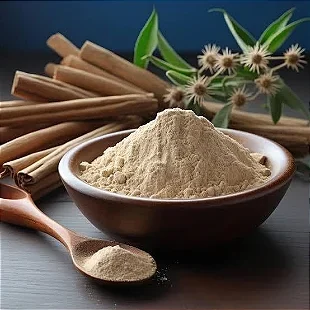
Withania somnifera, known as ashwagandha in Ayurvedic tradition, is classified in the modern research literature as an adaptogen. MaxForce's own ingredients page describes it as "the most-studied adaptogen in the category," trialled mainly on stress and sleep over eight-to-twelve-week windows, and its own copy already flags that it "can affect thyroid function and blood pressure" and advises discussing it with a doctor if you take medication. This article exists to show the actual studies behind that one sentence.
The thyroid evidence: this is not a hypothetical interaction
A randomized, double-blind, placebo-controlled trial conducted at a single center in India enrolled 50 adults with subclinical hypothyroidism — elevated TSH without overt symptoms — and gave half of them 600 mg of ashwagandha root extract daily for eight weeks, with the other half on placebo. Serum TSH, T3 and T4 all changed significantly compared to placebo, and the authors reported the treatment "effectively normalized" thyroid indices in that subclinical hypothyroid population (Sharma, Basu & Singh, J Altern Complement Med, 2018). Read that result in both directions. In people with an underactive thyroid, it moved hormone levels toward normal. That same pharmacological activity is exactly why it is not automatically safe for someone whose thyroid is already overactive, or who is on a fixed dose of thyroid medication calibrated to their current hormone levels — a supplement that measurably shifts TSH, T3 and T4 in one direction in trial subjects can, in principle, push a different person's levels the wrong way.
That is not just theoretical. A case report published in 2024 in the journal Cureus describes a previously healthy 47-year-old man who developed thyrotoxicosis — specifically painless thyroiditis, confirmed by thyroid ultrasonography and scintigraphy — roughly two months after starting ashwagandha, with fatigue, night fever, weight loss, diarrhea and headache as presenting symptoms (Hayashi et al., Cureus, 2024). Both his symptoms and his thyroid markers improved after he stopped taking it. The authors explicitly frame the case as raising a question about ashwagandha's safety for thyroid function in otherwise healthy people. A second, earlier case report documented thyrotoxicosis following ashwagandha use as well (van der Hooft et al., Ned Tijdschr Geneeskd, 2005). Case reports describe individual patients rather than population-level rates, so they cannot tell you how common this is — but a trial showing ashwagandha measurably changes thyroid hormones, plus two independent case reports of thyrotoxicosis following its use, is a consistent enough pattern that "talk to your doctor if you have thyroid disease or take thyroid medication" is not boilerplate caution. It is a specific, evidence-based instruction.
The blood pressure evidence
A randomized, double-blind, placebo-controlled Phase III trial published in the journal Stress in 2026 enrolled 60 patients who already had diagnosed hypertension alongside stress, anxiety and cardiometabolic risk factors, and gave half of them a standardized ashwagandha extract (300 mg twice daily) for 60 days on top of their existing care. Anxiety and stress scores fell substantially compared to placebo — the Hamilton Anxiety Rating Scale dropped 26.94%, GAD-7 fell 50.77%, and the Perceived Stress Scale fell 30.47% — and the paper reports cortisol declined 28.99%, triglycerides fell 13.00%, and there were "favorable trends" in LDL and blood pressure, with no serious adverse events (Pattojoshi et al., Stress, 2026). Read the design again: every participant already had hypertension and was already being medically managed for it when ashwagandha was added. The trial is genuinely encouraging as a signal that ashwagandha can be a reasonable adjunct alongside standard hypertension care under medical supervision — and it is also a direct demonstration that ashwagandha has its own blood-pressure-relevant activity, which is precisely why adding it to an existing blood pressure regimen without your prescriber's knowledge is a bad idea rather than a neutral one. An unsupervised addition of an active compound to a blood-pressure medication regimen risks an additive drop that a supervised trial protocol is specifically designed to catch and manage.
MaxForce's own ingredients page independently reaches a compatible caution for a second reason: L-arginine, also on the five-ingredient label, is described in the same ingredients section as an amino acid that "can lower blood pressure," and the site's own who-it's-for section separately tells readers to "use extra care" if they take blood-pressure medicine. With two of the five named ingredients each carrying their own blood-pressure-related profile in the literature, a combined product is not the place to assume the effects simply cancel out or stay negligible.
Who this points to specifically
- Anyone with hyperthyroidism, Graves' disease or a history of thyroiditis — ashwagandha's demonstrated effect on TSH, T3 and T4 is a real reason for caution, not a theoretical one.
- Anyone on thyroid hormone replacement or anti-thyroid medication — a supplement that moves thyroid hormone levels can complicate a dose that was calibrated without it.
- Anyone on prescription blood pressure medication — both ashwagandha and L-arginine, two of the five named MaxForce ingredients, have their own blood-pressure-relevant activity in the literature.
- Anyone pregnant or breastfeeding — ashwagandha is generally advised against in pregnancy and lactation due to insufficient safety data, independent of the thyroid and blood pressure questions above.
- Anyone with liver disease, or taking sedatives or immunosuppressants — documented separately in the liver-injury case literature on ashwagandha, distinct from the thyroid and blood pressure profile covered here.
Questions worth taking to a doctor or pharmacist before you start
Because the label discloses a combined amount rather than a per-ingredient one, a useful pre-purchase conversation with a doctor or pharmacist is less about a specific milligram figure and more about your own risk profile. Worth raising directly: whether you have ever been diagnosed with hyperthyroidism, hypothyroidism, Graves' disease or any thyroid nodule, and whether you take any thyroid medication with a dose that was calibrated to your current lab values; whether you take prescription blood pressure medication, and whether your blood pressure is currently well controlled or borderline; whether you take sedatives, benzodiazepines or other medications with central nervous system effects, since ashwagandha's traditional classification as a mild sedative-adaptogen raises a theoretical additive-sedation question separate from the thyroid and blood pressure profile covered here; and whether you have any history of liver disease, given the separate case-report literature on ashwagandha-associated liver injury. None of these questions requires knowing the exact ashwagandha dose in a MaxForce gummy to be worth asking — they depend on your own health history, not on the label's math.
Why a proprietary blend makes this harder, not easier
Every trial cited above used a specific, disclosed daily dose — 600 mg in the thyroid trial, 600 mg total (300 mg twice daily) in the blood pressure trial. MaxForce's own ingredients page states a combined 82 mg per serving across all five ingredients, footnoted as equivalent to approximately 567 mg of dry powders, with no individual milligram figure for ashwagandha published on the pages we reviewed. That means there is no way to compare the ashwagandha exposure in one MaxForce gummy against the doses used in the trials above. It could be a small fraction of the total 82 mg or a larger share; the label does not say, and this article will not guess a split it cannot verify. If you have any of the risk factors above, that uncertainty is itself a reason to have the conversation with a doctor or pharmacist before starting, rather than assuming an undisclosed amount is automatically too small to matter.
Why "no dose printed" is a safety question, not just a transparency one
It is worth being precise about why the missing per-ingredient dose matters here specifically, beyond the general principle that more disclosure is better. Every adverse effect described above — the thyroid hormone shifts, the case reports of thyrotoxicosis, the blood-pressure trends — was observed at a known, stated dose in a controlled setting where researchers were actively monitoring for exactly that kind of change. A person taking MaxForce has no equivalent monitoring and no equivalent dose information, only the finished gummy and the combined 82 mg figure. That does not mean harm is likely; the ingredient amounts in a gummy formulated for a mainstream retail audience are plausibly on the lower end of what appears in a therapeutic trial. But "plausibly lower" is not the same as "known to be low enough to be inert for someone with a thyroid or blood pressure condition," and the honest answer to "how much ashwagandha am I actually taking" is that neither this article nor the label can tell you.
This article is general information, not medical advice. If you have thyroid disease, high blood pressure, or take medication for either, speak with your doctor or pharmacist before starting any ashwagandha-containing product, including MaxForce. Seek prompt medical attention for symptoms such as rapid heartbeat, unexplained weight change, fever, or a sudden change in blood pressure.
Frequently asked questions
Can ashwagandha affect the thyroid?
Yes. A randomized, placebo-controlled trial in subclinical hypothyroid patients found that 600 mg daily of ashwagandha root extract significantly changed serum TSH, T3 and T4 over eight weeks compared to placebo. A separate published case report describes a healthy man who developed painless thyroiditis, a form of thyrotoxicosis, two months after starting ashwagandha, which resolved after he stopped taking it.
Can ashwagandha lower blood pressure?
A 2026 randomized, placebo-controlled trial in patients with pre-existing hypertension and cardiometabolic risk factors reported favorable trends in blood pressure alongside reductions in stress, anxiety and cortisol over 60 days. That trial enrolled people already on standard hypertension management, so the finding is about ashwagandha added on top of existing blood pressure care, not about ashwagandha used alone to treat high blood pressure.
Is it safe to combine ashwagandha with blood pressure medication?
Not something to decide without medical advice. Because ashwagandha has shown its own blood-pressure-related effects in trials, combining it with prescription blood pressure medication could have an additive effect. MaxForce's own site copy states plainly that anyone on blood-pressure medicine should talk to a doctor or pharmacist before starting.
What dose of ashwagandha is in a MaxForce gummy?
Not published. MaxForce discloses a combined 82 mg per serving across five ingredients, with no individual milligram amount for ashwagandha or any other named ingredient. The clinical trials referenced in this article used specific, disclosed doses of a standardized extract, which is not the same as the undisclosed amount in this finished gummy.
Check the current MaxForce label, price and guarantee
Package contents, price, shipping and the 60-day return window are set by the seller and can change without notice. Confirm them on the official order page before you buy.
Order MaxForceReferences
- Sharma AK, Basu I, Singh S. Efficacy and Safety of Ashwagandha Root Extract in Subclinical Hypothyroid Patients: A Double-Blind, Randomized Placebo-Controlled Trial. J Altern Complement Med. 2018 Mar;24(3):243-248. PubMed: 28829155
- Hayashi M, Hamada H, Azuma SI, Hayashi K. Painless Thyroiditis by Withania somnifera (Ashwagandha). Cureus. 2024 Mar 1;16(3):e55352. PubMed: 38559552
- van der Hooft CS, Hoekstra A, Winter A, de Smet PA, Stricker BH. [Thyrotoxicosis following the use of ashwagandha]. Ned Tijdschr Geneeskd. 2005. PubMed: 16355578
- Pattojoshi A, Kumar Patra S, Idrees SA, Behera S, Dalua SS, Tiwari P, Valavan R. Safety and efficacy of ashwagen (a standardized withania somnifera extract) in stress and anxiety with hypertension and associated cardiometabolic risk factors: a randomized, placebo-controlled trial. Stress. 2026 Dec 31;29(1):2669544. PubMed: 42105298
These references cover ashwagandha as studied in specific trial doses and in individual case reports. None tested the finished MaxForce gummy, which has no published trial of its own and does not publish an individual ashwagandha dose.